

25 Timeless Travel Quotes From History's Greatest Thinkers
 BagsAway Team
Some of the most powerful words ever written about travel came not from bloggers or influencers, but from philosophers, poets, and rulers who lived thousands of years ago. Their world had no airports, no GPS, no rolling suitcases — just open roads, uncertain seas, and the deep human pull to see what lies beyond the horizon.
These 25 quotes span over 2,500 years of human thought, from ancient Greece to imperial China to the Roman Empire. What makes them remarkable is how little has changed. The reasons people travel today — curiosity, growth, freedom, wonder — are exactly the same reasons Aristotle packed his bags in 340 BC.
Ancient Greek Philosophers
The Greeks practically invented the idea that travel is essential to a well-lived life. For them, seeing the world wasn't a luxury — it was education.
1. Democritus (c. 460–370 BC)
"For the wise it is easy to go anywhere. The whole world is home for a good soul."

Democritus traveled extensively through Egypt, Persia, and Ethiopia at a time when most people never left their village. He spent his family's entire inheritance on travel — and considered it the best investment he ever made. His atomic theory of the universe came directly from observing different cultures and their ways of understanding the world.
2. Aristotle (384–322 BC)
"Adventure is worthwhile."
Three words. That's all Aristotle needed. The man who tutored Alexander the Great and wrote foundational texts on everything from physics to politics understood that direct experience beats secondhand knowledge. Alexander would go on to travel farther than any Greek before him — perhaps his teacher planted the seed.
3. Socrates (c. 470–399 BC)
"Wisdom begins in wonder."
Socrates rarely left Athens, but his point stands: the feeling of wonder — the same feeling you get stepping into a foreign city for the first time — is where all real learning begins. Travel is one of the fastest ways to get there.
4. Aristophanes (c. 446–386 BC)
"Why, I'd like nothing better than to achieve some bold adventure, worthy of our trip."
Aristophanes was the ancient world's greatest comedy writer. This line comes from The Frogs, where the god Dionysus literally travels to the underworld. Even in comedy, the Greeks understood that a great trip needs a great story.
5. Euripides (c. 484–407 BC)
"Experience, travel — these are an education in themselves."
Euripides wrote over 90 plays, many set in far-flung locations. He understood that classroom learning only goes so far. The real curriculum is out there — in markets, on mountain passes, in conversations with strangers who see the world completely differently than you do.
Eastern Philosophers
While the Greeks debated in the agora, thinkers across Asia were developing their own profound relationship with the road.
6. Buddha (c. 563–483 BC)
"It is better to travel well than to arrive."
This might be the most quoted travel line in history, and it's pure Buddhism: the destination is not the point. The quality of your attention along the way is. Whether you're on a 14-hour flight or walking through a new neighborhood, how you travel matters more than where you end up.
7. Confucius (c. 551–479 BC)
"Wherever you go, go with all your heart."
Confucius spent 14 years wandering from state to state across China after being exiled from his home in Lu. He could have been bitter. Instead, he used those years to refine his philosophy and teach anyone who would listen. His advice is deceptively simple: don't half-travel. Be fully present wherever you are.
8. Confucius
"It does not matter how slowly you go as long as you do not stop."
A second entry because Confucius earned it. This is the perfect mantra for anyone grinding through a long layover, a delayed train, or a trip that's not going according to plan. Progress, not speed.
9. Lao Tzu (c. 6th–4th century BC)
"A good traveler has no fixed plans and is not intent on arriving."
The founder of Taoism essentially described the modern concept of slow travel 2,500 years early. No rigid itinerary, no rushing from sight to sight. Just openness to wherever the road takes you. Lao Tzu reportedly left China riding a water buffalo into the mountains and was never seen again — the ultimate open-ended trip.
Roman Thinkers
The Romans built the roads. Then they built an empire. And then they reflected on what all that movement meant.
10. Seneca (c. 4 BC–65 AD)
"Travel and change of place impart new vigor to the mind."
Seneca was a Stoic philosopher, advisor to Emperor Nero, and one of the wealthiest men in Rome. Despite his wealth and power, he kept returning to the same insight: staying in one place too long dulls the mind. A change of scenery — even a short one — resets your perspective.
11. St. Augustine (354–430 AD)
"The world is a book, and those who do not travel read only a page."
Possibly the most famous travel quote of all time. Augustine was born in North Africa, studied in Carthage, taught in Rome, and became Bishop of Hippo. His life was the quote in action. Every city he lived in added a chapter to his understanding of the world.
12. Marcus Aurelius (121–180 AD)
"Loss is nothing else but change, and change is nature's delight."
The philosopher-emperor who ruled Rome from the saddle during military campaigns across Europe. Aurelius didn't travel for pleasure — but he found wisdom in the constant motion of his life. Leaving behind the familiar is a kind of loss, but it's also how you grow.
Medieval and Renaissance Travelers
As the ancient world gave way to new empires and exploration, a fresh generation of thinkers carried the torch.
13. Ibn Battuta (1304–1369)
"Traveling — it leaves you speechless, then turns you into a storyteller."
Ibn Battuta is the most traveled person in pre-modern history. Over 30 years, he covered roughly 73,000 miles across Africa, the Middle East, Central Asia, South Asia, Southeast Asia, and China. No one before the age of steam saw more of the world. His Rihla (travelogue) remains one of the greatest travel books ever written.
14. Muhammad (570–632)
"Don't tell me how educated you are, tell me how much you traveled."
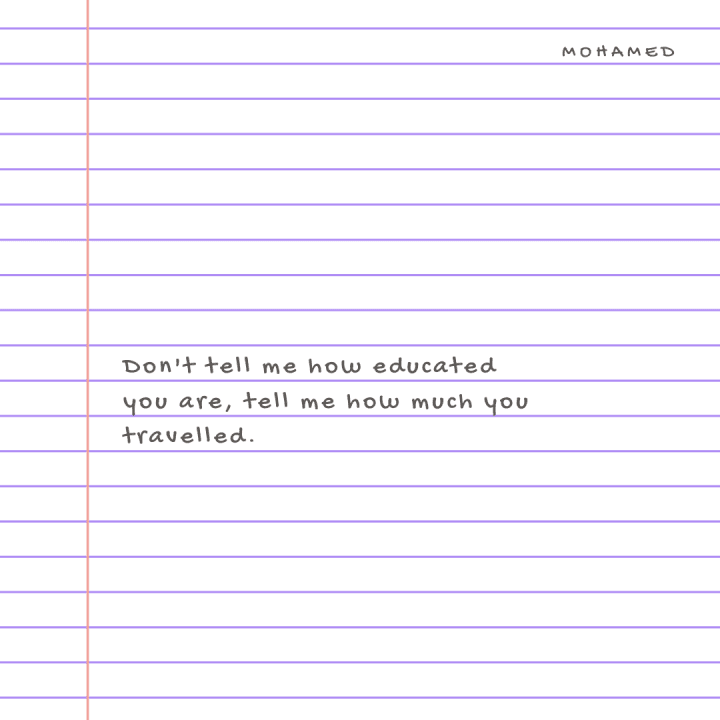
A merchant and caravan trader before his prophetic calling, Muhammad traveled the trade routes of the Arabian Peninsula extensively. His emphasis on travel as the true measure of education reflects a worldview shaped by direct experience rather than books.
15. Leonardo da Vinci (1452–1519)
"Once you have tasted flight, you will forever walk the earth with your eyes turned skyward."
Da Vinci dreamed of human flight centuries before the Wright brothers. He moved between Florence, Milan, Rome, and France throughout his life. For Leonardo, movement and vision were inseparable.
16. Michel de Montaigne (1533–1592)
"I do not speak the minds of others except to speak my own mind better."
Montaigne traveled through Italy, Germany, and Switzerland keeping detailed journals. He believed travel's purpose was to challenge your own assumptions — not to confirm them.
Poets and Literary Travelers
Writers have always understood that the road and the page are connected.
17. Hans Christian Andersen (1805–1875)
"To travel is to live."
Four words from the Danish storyteller who wrote The Ugly Duckling and The Little Mermaid. Andersen spent years traveling across Europe, and many of his best stories were inspired by the places he visited.
18. Robert Louis Stevenson (1850–1894)
"I travel not to go anywhere, but to go. I travel for travel's sake. The great affair is to move."
The author of Treasure Island spent much of his life traveling — partly for his health, partly because he couldn't stop. He eventually settled in Samoa, about as far from his native Scotland as you can get.
19. Marcel Proust (1871–1922)
"The real voyage of discovery consists not in seeking new landscapes, but in having new eyes."
Proust spent most of his later life in a cork-lined bedroom, which makes this quote all the more striking. Travel doesn't require a plane ticket. It requires a shift in perception.
20. J.R.R. Tolkien (1892–1973)
"Not all those who wander are lost."
From The Lord of the Rings. A single line from a poem about Aragorn that became the unofficial motto of every traveler with a backpack and no fixed return date.
Modern Voices
The spirit of ancient travel philosophy lives on in more recent words.
21. Mark Twain (1835–1910)
"Travel is fatal to prejudice, bigotry, and narrow-mindedness."
Twain traveled extensively through Europe, the Middle East, and the Pacific. His book The Innocents Abroad is one of the best-selling American travel books ever. His quote cuts to the core: travel doesn't just entertain you — it makes you a better person.
22. Helen Keller (1880–1968)
"Life is either a daring adventure or nothing at all."
Keller traveled the world despite being deaf and blind from childhood, visiting 35 countries across five continents. If she could embrace adventure with those limitations, most excuses for not traveling fall apart.
23. T.S. Eliot (1888–1965)
"We shall not cease from exploration, and the end of all our exploring will be to arrive where we started and know the place for the first time."
From Little Gidding. Eliot captures something every returning traveler knows: you come home the same person to the same place, but somehow everything looks different.
24. Anthony Bourdain (1956–2018)
"Travel changes you. As you move through this life and this world you change things slightly, you leave marks behind, however small."
Bourdain turned food and travel into a form of journalism that reached millions. He showed that travel isn't just about sightseeing — it's about sitting at a table with strangers, sharing a meal, and listening.
25. Pico Iyer (1957–)
"Travel is not really about leaving our homes, but leaving our habits."
Iyer, one of the great modern travel writers, nails the uncomfortable truth: the hardest part of travel isn't logistics — it's letting go of your routine, your comfort zone, and the person you are at home.
What 2,500 Years of Travel Wisdom Tells Us
Look at these 25 quotes together and a pattern emerges. Across centuries, continents, and wildly different cultures, the greatest thinkers keep saying the same things about travel:
- It educates you more than any school (Euripides, Muhammad, Twain)
- The journey matters more than the destination (Buddha, Lao Tzu, Stevenson)
- It requires courage (Aristotle, Aristophanes, Keller)
- It changes how you see everything (Proust, Eliot, Iyer)
- The world is meant to be explored (Augustine, Democritus, Tolkien)
Two thousand years from now, someone will probably say something very similar. The technology changes. The insight doesn't.
Ready to explore? Travel lighter and see more. BagsAway offers secure luggage storage starting at .95/bag in 1,000+ locations worldwide — so you can wander freely, just like the philosophers intended.
BagsAway Team
Travel experts helping you explore the world bag-free.