







Bayfront Park at a glance
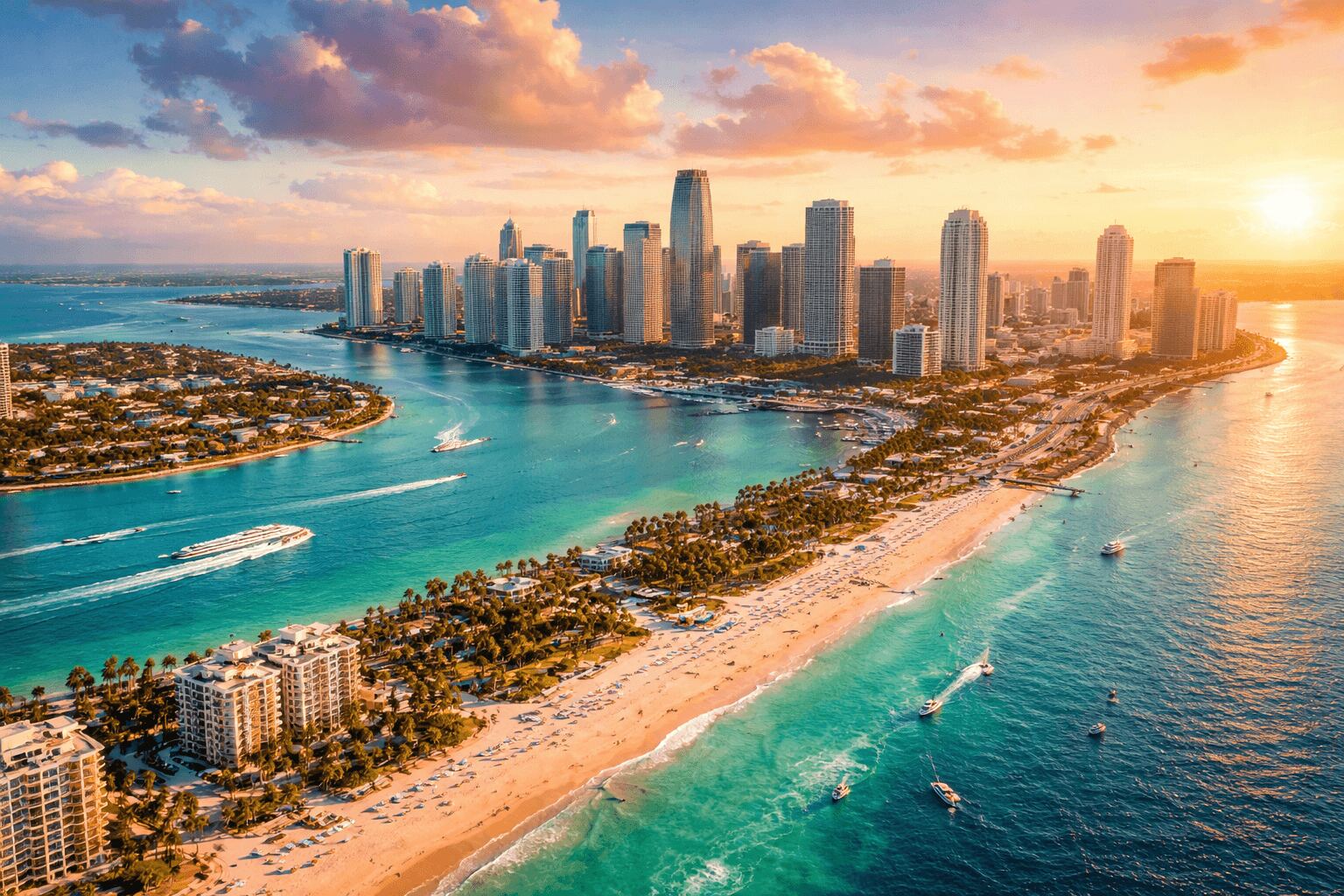
Bayfront Park covers 32 acres of downtown Miami along Biscayne Bay, at 301 Biscayne Blvd. It's run by the Bayfront Park Management Trust, a limited agency of the City of Miami.
Bayside Marketplace borders it to the north and the InterContinental Hotel to the south, with Biscayne Boulevard along the west side.
Inside there's a small sand beach, a tropical rock garden with a waterfall, a fountain, the Light Tower and several monuments.
Opening hours and what's inside Bayfront Park
Open daily from 7:00 AM to 11:00 PM, 365 days a year. Admission is free.
People come to walk, run, skate, picnic and exercise, or just to look at the bay, the yachts and the skyline. You'll find a playground, a dog park, picnic tables, public restrooms, cycling lanes and a skateboarding area. The Lee & Tina Hills Playground sits at the south end beside the Tina Hills Pavilion. It's aimed at children aged 5 to 12. There's a pirate ship to board, plus slides, climbing areas and a sea-life sculpture.
Two event spaces: the amphitheater and the Tina Hills Pavilion
There are two places to catch an event here.
The bigger one, the amphitheater, takes up to 10,000 people, with 2,672 fixed bench seats and room for 7,328 on the lawn. When it was rebuilt in 2020 it gained a solar energy canopy, and these days it goes by the FPL Solar Amphitheater.
The Tina Hills Pavilion is smaller: 1,000 people, 200 in fixed seats and 800 on the lawn. Smaller performances and outdoor receptions are held there, and so are the park's free yoga classes.
How to get to Bayfront Park by Metromover, car or rideshare

The easiest way in is the free Metromover. Its Bayfront Park station is right next to the park, and First Street, College/Bayside and College North aren't far either.
Parking nearby is limited and you pay for it, so on busy days public transport or a rideshare drop-off saves trouble.
Driving? Put 301 Biscayne Boulevard in your GPS, take I-95 to Exit 2A and head east on NE 3rd Street towards the bay. Paid parking is next to the Trust's offices, and the Bayside Marketplace garage is another option. If the park's spaces fill up, the amphitheater points drivers to Lot 19-2 at 300 NE 1st Ave, with a stay of between 2 and 8 hours.
Park rules and gate security for a first visit

No alcohol in the park, except at authorised events. Leashed dogs are welcome; motorised or battery-operated bikes and scooters aren't. You can't swim or fish, drones need the Trust's permission, and camping is banned, along with temporary structures such as tents, chairs and hammocks.
Going to an amphitheater event? Allow time at the gate.
Security uses metal detectors and checks bags, and the queue is shorter if you get there early. Each event can add its own rules on top of the general ones. Read the page for yours before you leave the hotel.
A park won back from the bay
Bayfront Park started out in 1896 as Royal Palm Park, the first public gathering space in Greater Miami: a pavilion and some green space, used for baseball games and track and field.
The land itself came from the water.
In 1922 the city built a retaining wall and spent 17 months reclaiming the shoreline. Work on the current park began in 1924. Its designer was Warren Henry Manning, who had worked for Frederick Law Olmsted, Sr., and the park opened in March 1925.
In World War II the U.S. Navy took the park over as a recreation centre for troops training in Miami. Even so, the city installed the Dade County War Memorial there in 1943. The park came back to city hands in 1950.
The parking lot that never happened, and the sculptor who opened up the view
In 1947 the Miami City Commission weighed a business group's proposal to turn the park into a parking lot, with a smaller waterfront park tucked to the east. The park survived, which anyone circling downtown for a space can appreciate.
By 1980 the park was down to 32 acres, and the city commissioned sculptor Isamu Noguchi to redesign it. He talked the city into demolishing a waterfront library that blocked the view of the bay and into extending Manning's promenade again, so it now ends at a spray fountain. Noguchi died while the park was being built. His longtime collaborator Shoji Sadao oversaw the plans.
His Light Tower stands 40 feet tall, an abstract nod to Japanese lanterns and moonlight over Miami. Over on the eastern side, the Mildred and Claude Pepper Fountain, a musical fountain, opened in 1990 as a key part of his concept.
One thing never got built: a Greek-style amphitheater designed by architect Walter DeGarmo in 1945.